An image can make a public conversation feel immediate. It can also leave the most important questions outside the frame.
Before deciding what a gathering means, separate the image from the claims attached to it. The picture, the caption and the surrounding article are different parts of an account. Each needs to be understood on its own terms. A confident caption is still a statement that should have a source.
Describe what you can actually see.
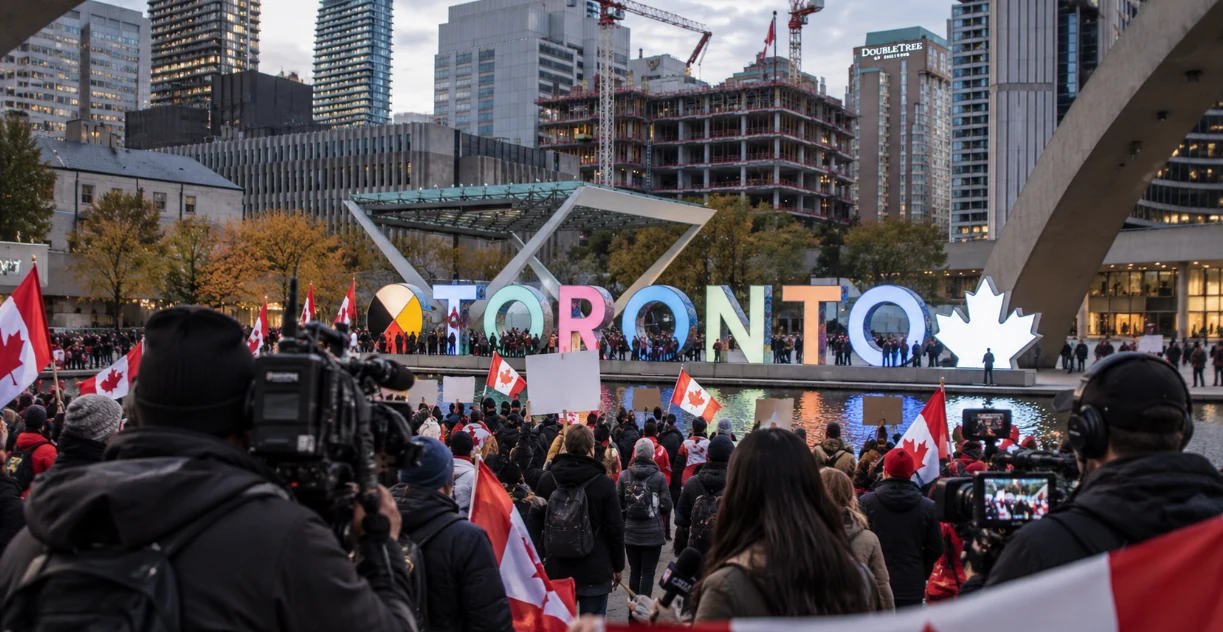
Start with a plain description: people in a public space, a recognisable building, signs or camera equipment. Do not move straight from those details to a conclusion about why everybody is there. A flag does not tell you the views of each person nearby; a camera does not establish which outlet, if any, is reporting.
It is also easy to overread a crop. One view cannot show every entrance, the full extent of a gathering or what happened before and after the moment. Avoid estimating attendance from an illustration or treating the people closest to a camera as representatives of a whole city.
Ask what the caption is asking you to believe.
A useful caption distinguishes documented information from interpretation. Look for a location and date, a credit and a description that matches the evidence. If the caption names an organiser or cause, ask where that identification came from. If it describes an outcome, look for more than the image itself.
The Toronto scenes in this journal are explicitly labelled editorial illustrations. They support a discussion of public space and community activity. We do not use them to verify a particular gathering, identify a movement or attribute views to the people shown. The same distinction should remain clear if the image is shared alongside a link to an article.
Follow the notice back to its origin.
For an event you are considering attending, find the original organiser’s notice and check whether it is current. Confirm the precise place, date, format and any registration instructions there. A repost may be incomplete or may refer to an earlier occasion. When a detail is unclear, keep it marked as unconfirmed.
The City’s Nathan Phillips Square events page is one useful starting point for the square and links readers to organisers for details. Its calendar is not a universal record of every activity in the space. The broader City festivals and events directory also links to City and community-run listings; inclusion does not make every event a City-produced event.
Official sourceCity of Toronto — Nathan Phillips Square events
Official sourceCity of Toronto — festivals and events
For a formal City consultation, use the project page on Have Your Say Toronto. Check what input is being sought and which stage the project has reached. A page describing a concluded process is background information, not an invitation to submit a response today.
Official sourceCity of Toronto — Have Your Say Toronto
Separate a request from a decision.
People gathering around an issue may be discussing an idea, requesting a change or reacting to something already decided. Those are different stories. A headline that moves directly from “people called for” to “the City will” has skipped a question: where is the actual decision recorded?
When the subject is committee or Council business, start with the City’s participation guidance and follow the agenda links to the relevant item. The guidance explains how written comments and requests to speak fit into the process. A submitted comment is not, by itself, a decision on the issue.
Official sourceCity of Toronto — Council and committee participation
Illustrative reading exercise
A caption is a claim to check.
Imagine a post showing a busy square with the words “Our neighbourhood has decided.” Before repeating it, ask which neighbourhood, who took part and where that decision can be read. The picture may show people together while leaving all three questions unanswered. This is an invented example for reading practice, not a report about a Toronto organisation.
Keep uncertainty in the story you pass on.
If you share an article, preserve its date and original link. If you have only a claim, call it a claim. Do not replace a careful account with a more dramatic summary, or attach an unrelated picture as though it documents the event. Accuracy includes the limits of what you know.
A useful final question is simple: could another reader follow the same source and understand how I reached this description? If the answer is no, keep looking or leave the detail out. Good context makes a community conversation easier to join without making it louder than the evidence supports.
Explore the gatherings guide ↗